Leading FMCG Brands: Product Launches Are No Longer a Gamble, How to 'Predict' New Product Success Rates?
FMCG brands leverage Tezign's GEA to integrate historical launch data, social media trends, and competitor feedback, and based on consumer cognition, conduct parallel testing on four product directions, compressing the launch decision cycle from three weeks to 5 days, with a prediction accuracy exceeding 80% compared to actual feedback.
Category
Date
2026-08-04
Read Time
3 min read
The failure rate of new products in FMCG brands is a long-standing issue that has never been truly resolved.
The common explanations are 'insufficient research' or 'too quick decision-making.' But the deeper reason is that there is always a gap between the research cycle and the decision-making pace. By the time the research results come out, competitors have already captured consumer minds; what thirty people say in a focus group often differs from what millions of consumers do on the shelves. Brands are using a ruler to measure something they have never fully assessed.
A certain FMCG brand planned to launch a new product and discussed it internally for three weeks, but no one could determine 'how many people would actually buy this, and who those buyers would be.' The controversy was not due to a lack of team capability, but rather a lack of sufficiently dense signals to make a judgment. They decided to run it again using GEA.
Sensing: GEA integrates three types of signals into the Context System—historical launch data of the brand (which characteristics were effective among which demographics), semantic discussion trends on social media platforms for similar categories, and recent changes in user feedback from competitors. These signals are not viewed separately but are integrated into a dynamic 'market acceptance map' within the same context.
Reasoning: The Subjective World Model conducts cognitive modeling of the target demographic—not grouped by age, but by 'acceptance logic': some are persuaded by efficacy data, some by 'people like me are using it,' and some by ingredient stories. Each demographic corresponds to different acceptance reasons and common concerns. The system conducts parallel testing on four product directions, outputting acceptance predictions and main resistance points for each direction among different demographics.
Action: The output is not a research report, but rather 'which appeal resonates with which demographic, where concerns are most concentrated across channels, and which competitor's practices have established mental expectations'—structured conclusions that can be directly used to adjust product direction or launch strategy.
Write Back: Real feedback after the launch is written back into the Context System, allowing the judgment model to update with each new product iteration. The next new product decision can be advanced directly based on the previous one, rather than starting research from scratch.
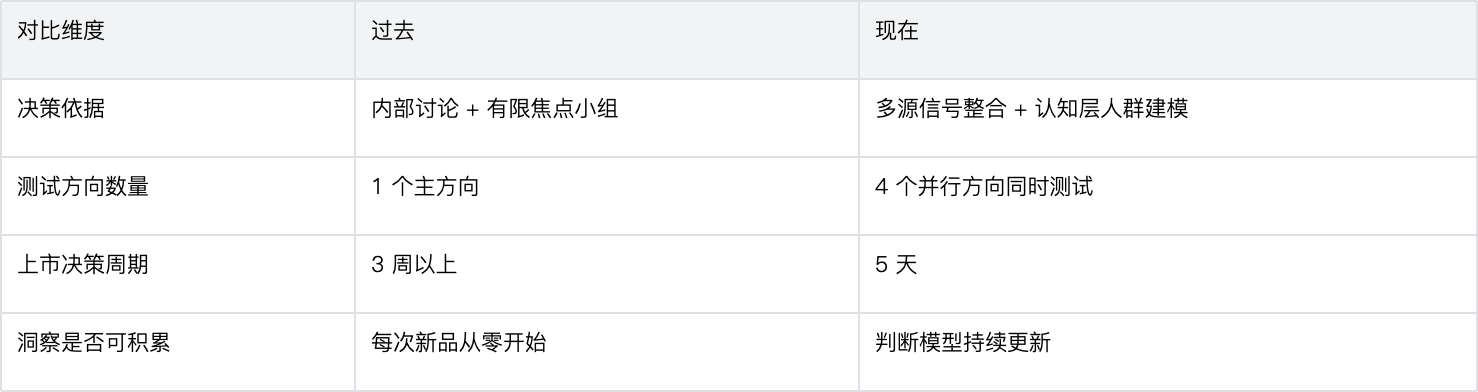
The alignment between actual feedback after the launch and the predicted direction exceeds 80%, compressing the launch decision cycle from three weeks to 5 days.
The essential change in new product decision-making is from 'taking a gamble' to 'making informed choices.'
This does not mean that GEA can guarantee the success of new products. Market changes, competitor actions, and execution quality—these variables still exist. But at the moment of making directional decisions, brands have for the first time a broader signal foundation than internal discussions, and for the first time, they have accumulated judgment assets across iterations.
Research conclusions are no longer one-time consumables but are continuously accumulating brand insight assets. With each new product launch, the system gains a better understanding of the brand's target users. The insight research GEA addresses is not the issue of slow research, but rather the problem of research conclusions that cannot be continuously accumulated.
Category
Date
2026-08-04
Read Time
3 min read
Related Recommendations

Competitive Perception Upgrade: Continuously and Dynamically Input Market Signals into Brand Cognition, Insights Experiment of a Global Leading Automotive Brand