Leading Automotive Brands: No Longer Blindly Following Thousands of Leads, Use GEA to Accurately Find the Right Users
Automobile brands leverage Tezan GEA to integrate multi-channel customer signals, identify the car buying stage and core concerns, recommend follow-up timing and content for sales, and continuously accumulate conversion experience, ultimately improving conversion efficiency by about 30%, transforming personal judgment into corporate capability.
Category
Date
2026-08-04
Read Time
3 min read
A sales operations leader from a certain automotive brand once said: "We handle thousands of leads every day, but we don't know which ones are real."
Test drive appointments, official website inquiries, in-store consultations, e-commerce favorites—data is abundant, but no one can clearly explain the status of the people behind each piece of data. The result is that interested customers are not followed up in a timely manner, while uninterested customers are repeatedly disturbed, leading to a significant waste of sales resources on ineffective communication. A deeper issue is that each salesperson relies on their own experience to judge lead quality, with inconsistent criteria, making it impossible to replicate good experiences. When someone leaves, they take not only customers but also the judgment logic with them.
This brand decided to rerun the process using GEA.
The first thing GEA does is integrate scattered behavioral signals.
Sensing: Behavioral data from CRM, official websites, e-commerce platforms, and customer service systems are integrated into the Context System, creating dynamic profiles for each lead customer. Each time a new behavior occurs—such as the duration spent on the configuration page, the frequency of mentioning competitors, or the shift in consultation topics from "price" to "delivery cycle"—the profile is updated in real-time. This is not about summarizing data into a single table, but about establishing a system that continuously perceives changes in customer status.
Reasoning: Based on historical transaction path data, the system labels each customer's current stage—awareness, comparison, or decision—and identifies the main resistance at that moment. What sales see is no longer just a timestamp, but a briefing: "This customer is in the decision stage, with the main concern being range; it is recommended to prioritize pushing real usage scenario content." The basis for judgment, action suggestions, and stage labels are presented together.
Action: Sales follow up according to the recommended path, pushing targeted content and arranging corresponding touchpoint actions. Execution no longer relies on personal experience, but on reference paths provided by the system.
Write Back: The results of actions are synchronized into the Context System—what type of content push led to appointments, which type of script had a high conversion rate at which stage, and which type of customer had a misjudgment in resistance—these data continuously accumulate, making the intent model for the next customer more accurate. With each transaction, the judgment system is updated.
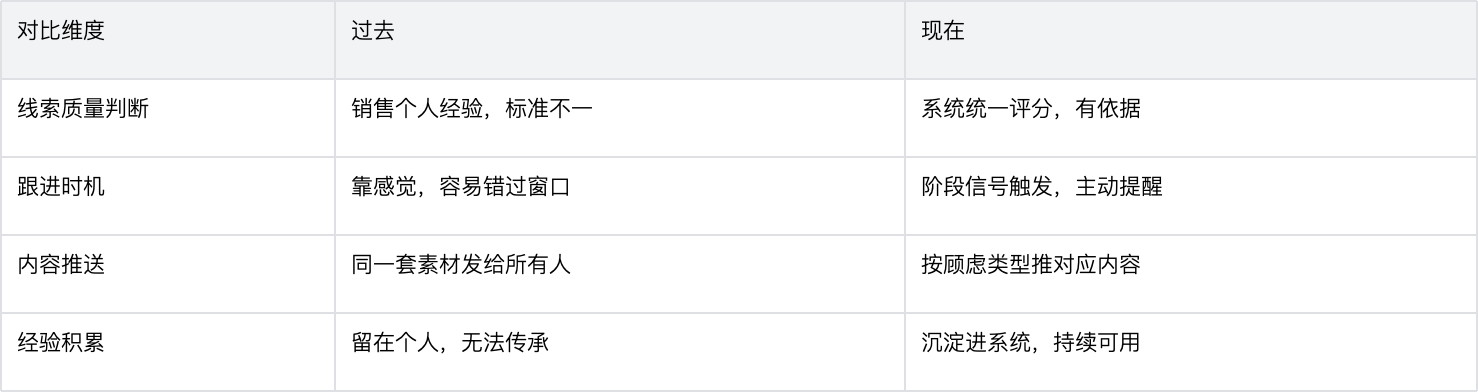
Conversion efficiency improved by about 30%, customer satisfaction scores increased, and the average follow-up cycle for the sales team shortened by 1.5 weeks. More importantly, this judgment system does not disappear when a salesperson leaves—it resides in the Context System, ready to be accessed by the next salesperson at any time.
Intent judgment has transformed from a one-time task into a continuously operating capability.
In the past, every judgment made by sales was isolated: this customer seems promising, that one does not. These judgments were kept in their minds, not accumulated, not transmitted, and not iterated. After introducing GEA, every judgment is recorded, and every correct judgment leaves a trace in the system for future reference.
This is where Insight Research GEA differs from traditional CRM: CRM records behavior, while GEA understands motivation and turns judgment into a sustainable asset that can be called upon. The time companies spend developing sales judgment can now start to compound.
Category
Date
2026-08-04
Read Time
3 min read
Related Recommendations

Global Narrative Reconstruction: Don't Let Globalization Become 'Translation', How GEA Solves the Multi-Market Content Dilemma for Global Manufacturing Giants

Brand Hidden Assets: Turning Employee Knowledge into a Growth Engine, A Food Brand's GEA Content Growth Practice