All
Systematic Evaluation of AI Content (Eval): Why the Evaluation Process Matters More Than the Evaluation Result
Systematic evaluation of AI content focuses on process evaluation. By relying on Tezign GEA to record generation paths and trace judgments, it builds a quality closed loop, enabling AI content production to compound over time and preventing errors from accumulating continuously.
Category
All
Date
2026-11-11
Read Time
5 min read
Technical positioning of this article: The “Systematic Evaluation of AI-Generated Content” discussed here focuses on the core question—why, for enterprise AI content production, “how to evaluate” is more important than “what result the evaluation produces.” It is a key part of the quality closed loop in Tezign GEA’s content production, and is closely tied to the divergence–convergence mechanism of the Cognitive Reasoning Model (CRM). Understanding this distinction is a crucial step toward understanding why some enterprises’ AI content gets better the more they use it, while others get worse.
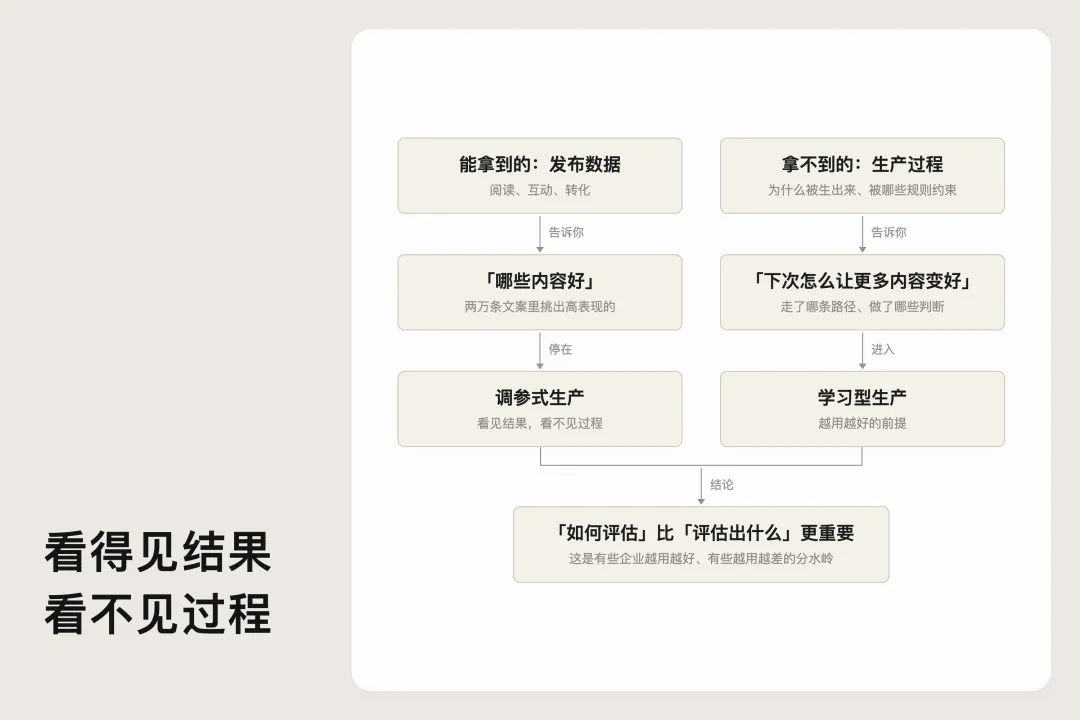
A marketing team at a global FMCG brand started using AI to generate social media content last year. Over the course of a year, AI produced nearly 20,000 pieces of copy and more than 10,000 images. The team size stayed the same, but output tripled. Not bad. But when they wanted to systematically review “which content really worked and which was just noise,” they ran into a problem.
What they could access was the performance data of the final content—views, engagement, conversion. What they could not access was why these pieces were generated in the first place, what judgments were made along the way, and which rules constrained them during production. In other words, they could see the result, but not the process.
This is not an isolated case. For most enterprises, AI content evaluation still stays at the “result level”—looking at data after launch and reviewing metrics afterward. But to make AI content production improve with use, it must move into the “process level”—evaluating which path the model took during generation, why it went there, and what judgments it made along the way.
Evaluating the “result” tells you “which content is good”; evaluating the “process” tells you “how to make more content good next time.” The gap between these two is the gap between “parameter-tuning production” and “learning-based production.”
Why process evaluation is harder than result evaluation
Result evaluation is relatively easy: publishing data, user feedback, and sales conversion are all quantifiable metrics. Process evaluation is hard because it requires opening the “black box” of how the model generates content.
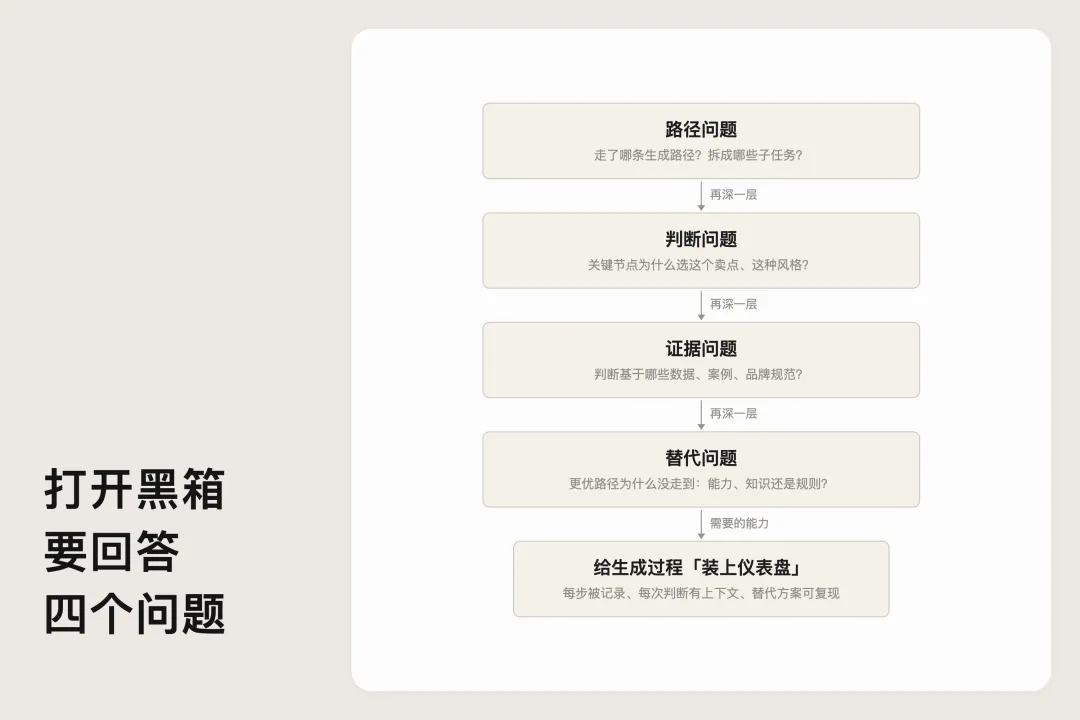
Specifically, process evaluation needs to answer four progressively deeper questions:
- Path question: From receiving the request to producing the result, what generation path did the model take? Into how many subtasks was it broken down? What method was used for each subtask?
- Judgment question: At key nodes along the path, what judgments did the model make? For example, “Why use this selling point instead of that one?” “Why use this style instead of that one?”
- Evidence question: What were these judgments based on? Which historical data was retrieved, which past cases were referenced, and which brand guidelines were followed?
- Alternative question: If there was a better path or judgment, why didn’t the model take it? Was it due to insufficient capability, lack of knowledge, or rules that did not allow it?
Answering these four questions does not require the ability to score final outputs; it requires the ability to “equip the generation process with a dashboard”—every step is recorded, every judgment has context, and every alternative can be reproduced.
The three core actions of systematic evaluation
To make process evaluation truly effective, enterprise AI content production needs to establish three things.
The first is structured recording of the process. Every AI content generation task is recorded in a structured way: what the input was, into which subtasks it was broken down, what method was used for each subtask, what intermediate results were produced, and what the final result was. This record is not for “showing the model,” but for “showing the team”—so the team can review every generation and accumulate experience from every iteration.
The second is tracing judgments at key nodes. Key decision points in the model’s generation process (such as “which selling point to choose,” “which style to use,” and “which standards to comply with”) are explicitly marked and accompanied by the basis for the judgment. When a piece ultimately performs well, the team can know which judgment made the difference; when it performs poorly, the team can know which judgment went off track. This tracing capability is the engineering foundation for “making AI understand this enterprise better the more it is used.”
The third is strategy optimization based on results. Once enough process records and outcome data are linked together, the system can begin to do something that is difficult for humans: identify “under what conditions, with what path, and through what judgments, high-performing content can be produced.” This is not as superficial as “tuning prompts”; it is “letting the strategy of AI production itself begin to learn.”
Together, these three things form the “quality closed loop” of AI content production: the process is recorded, judgments are traced, and strategies are optimized. Each round of production raises the starting point for the next round.
How it is implemented in Tezign GEA
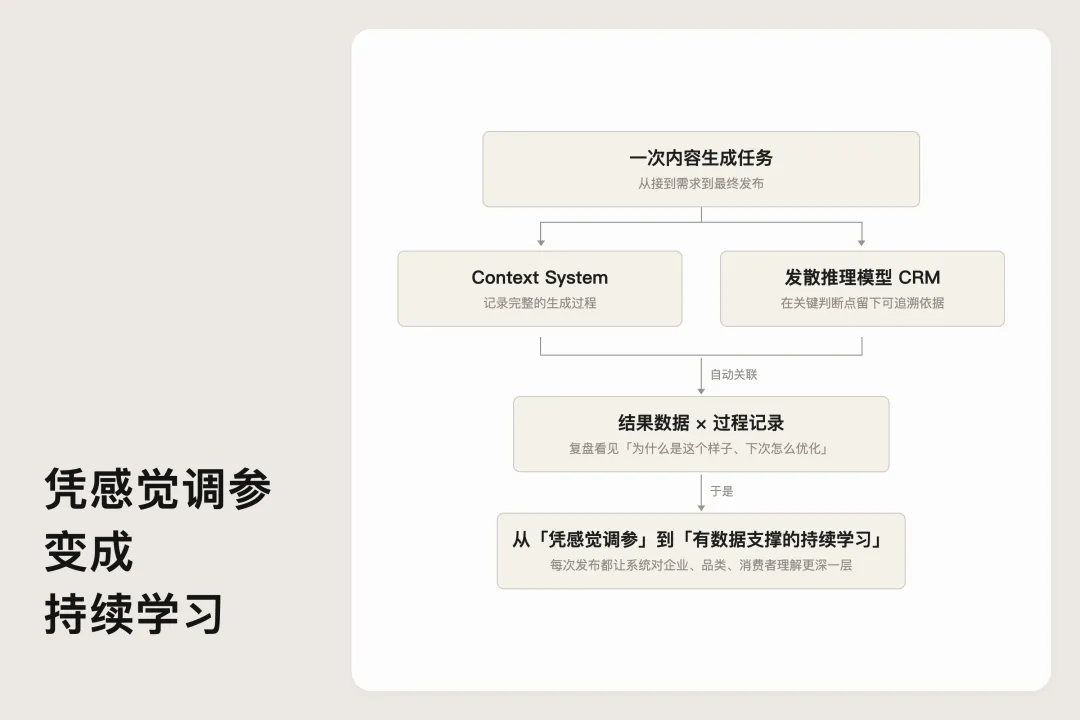
Tezign GEA builds this systematic evaluation capability into the content production closed loop. For every content generation task, the Context System records the complete generation process, the Cognitive Reasoning Model leaves traceable evidence at key judgment points, and the final result is automatically linked to the process record. When the team reviews the work, what they can see is not just “did this piece perform well,” but “why does this piece look the way it does, which past pieces is it related to, and how can similar tasks be optimized next time.”
The key change in this implementation is that AI content production shifts from “tuning by intuition” to “continuous learning supported by data.” Every piece of content sent out deepens the system’s understanding of “this enterprise, this category, and this group of consumers.”
Systematic evaluation is not an urgent priority for every enterprise. If AI content output is small, production frequency is low, and the category is singular, then reviewing results is enough, and the cost of building process evaluation is not worthwhile. But when an enterprise treats AI content production as an ongoing business, delegates generation capabilities to multiple teams, and regards content consistency as a core requirement—without process evaluation, it means “the more you use it, the faster errors accumulate.”
The criterion is equally straightforward: can your team now answer, “What path did AI take when generating last week’s batch of high-performing content?” If not, then what you are accumulating now is not capability, but debt. The essence of systematic evaluation is not evaluation itself, but making investment in AI content compound rather than become sunk cost.
Category
All
Date
2026-11-11
Read Time
5 min read
Related Recommendations

How Can Enterprises Make Cost-Effective Model Procurement Decisions? The Key Lies in Multi-Model Orchestration and Agent Harness

Why Benchmarking Large Models Can't Tell You If This AI Is Right for Your Business?