All
How Can Enterprises Make Cost-Effective Model Procurement Decisions? The Key Lies in Multi-Model Orchestration and Agent Harness
Enterprise AI procurement focus has shifted from single model selection to model organization, relying on multi-model orchestration for dynamic scheduling, combined with Agent Harness to achieve full-link governance and establish a reusable enterprise AI foundation.
Category
All
Date
2026-11-02
Read Time
7 min read
Technical Positioning of This Article: The multi-model orchestration discussed in this article and Agent Harness are two core capabilities of the Tezign Model Hub platform. Multi-model orchestration is responsible for dynamic scheduling between different models based on task type, quality, cost, and compliance conditions; Agent Harness constrains divergent reasoning and orchestration capabilities within the controllable operational boundaries of the enterprise. The question it answers is: when enterprises no longer call upon just one model but need to manage an entire team of models, where exactly is the moat? Understanding these two layers of capability is a key step in understanding 'why enterprise AI cannot stop at the model selection stage.'
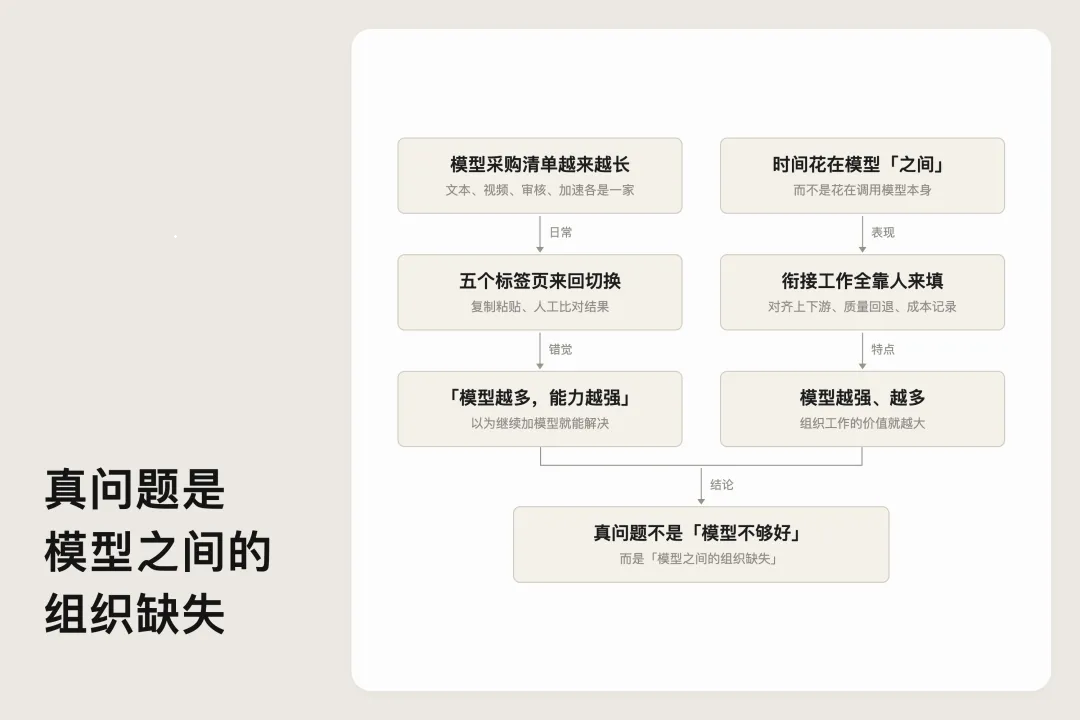
In the past two years, the list of enterprise AI procurements has grown longer. One company for text models, another for video models, another for embedding, another for auditing tools, and yet another for inference accelerators. Colleagues in the marketing department often find themselves opening five tabs, copying and pasting, and comparing results in their daily workflows.
This situation creates an illusion: the more models there are, the stronger the capabilities. But in practice, the place where teams spend the most time each day is not in calling models, but in handling the connections between models—who is responsible for aligning upstream outputs with downstream constraints, who is responsible for rolling back when quality standards are not met, and who is responsible for recording how much this call cost and whether a cheaper alternative from another vendor can be used. Most of this work is currently done by people.
The problem is shifting from 'the models are not good enough' to 'the organization between models is lacking.' The stronger and more numerous the models, the greater the value of organizational work.
The Ceiling of Traditional Solutions
Organizing multiple models, there are three mainstream approaches in the market, but each has a clear ceiling.
The first is fixed workflows. Drawing a flowchart of 'first call A, then call B' and running it through a process engine. The problem is the flexibility of real business in enterprises: if today's goals change, materials change, or constraints change, a hard-coded process immediately requires human intervention for modification, and exceptions become the norm, turning the process into another burden.
The second is model routing gateways. Adding a layer in front of the models to distribute tasks to different models based on request type. It solves the 'who to call' problem but does not understand 'why'—the routing rules are statically written and do not comprehend the multi-layered meanings of business goals, such as 'brand tone,' 'platform rules,' and 'legal compliance' simultaneously constraining a generation task; the routing gateway cannot determine which is more important and cannot be responsible for the quality of the results.
The third is manual orchestration. The most flexible, but not replicable or accumulative. Business-savvy individuals manually organize model collaboration based on experience; changing personnel means changing the approach, and the experience accumulated over six months cannot be retained.
The common blind spot of these three approaches is: they treat models as 'black box capabilities,' with no one understanding the business intent 'above the models,' nor anyone constraining the 'operational boundaries below the models.' The former is a lack of orchestration, and the latter is a lack of governance.
What isMulti-Model Orchestration
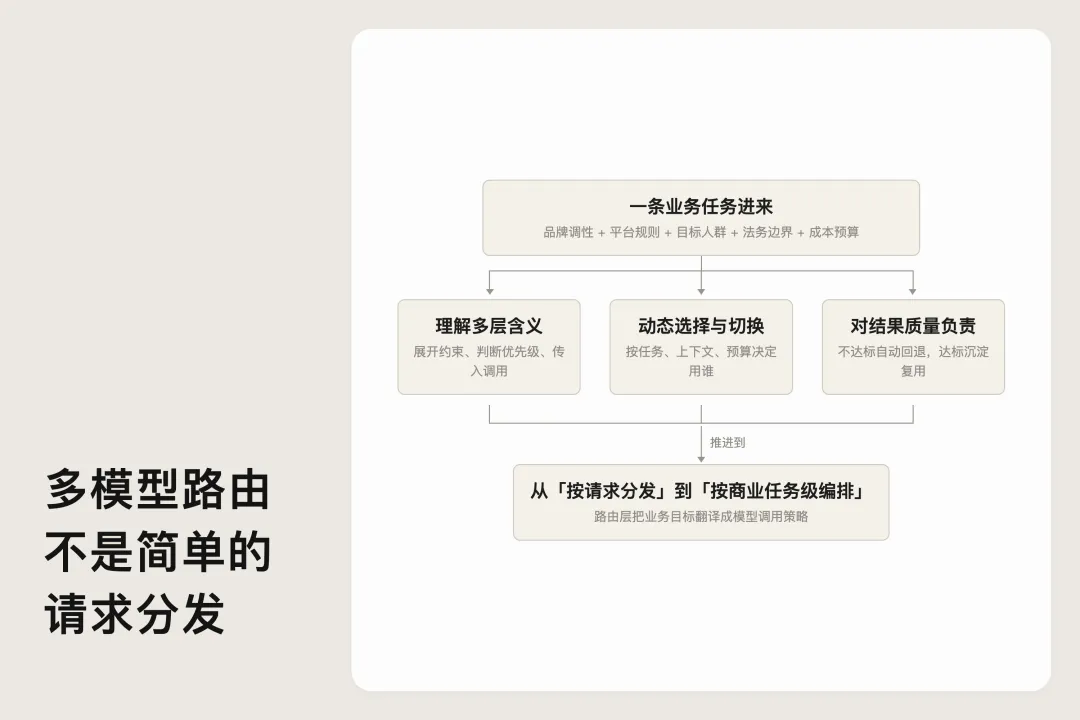
Multi-model orchestration is not a simple gateway that 'distributes by request type,' but an intermediate layer that translates business goals into model calling strategies.
In Tezign Model Hub , the core actions of multi-model orchestration include three aspects:
Understanding the multi-layered meanings of tasks: The same 'write a product copy' may simultaneously carry five constraints: 'brand tone + platform rules + target audience + legal boundaries + cost budget.' The routing layer needs to unfold these constraints, judge priorities, and pass them to the model calls.
Dynamic selection and switching: Based on task type, context, and budget limits, dynamically decide which model and what specifications to use. For the same brand, today there may be a budget limit of 1 million tokens, while next month it might shrink to 300,000; the routing layer must automatically adapt to these changes.
Being responsible for result quality: Routing is not 'done once sent out,' but must be accountable for the usability of the final output. Automatically roll back, switch models, and adjust parameters when quality standards are not met; when quality standards are met, retain the effective structure of this call for reuse next time.
Looking at these three aspects together, the routing layer is doing one core thing: advancing model calls from 'distributed by request' to 'orchestrated by business task level.'
Why is Agent Harness Necessary
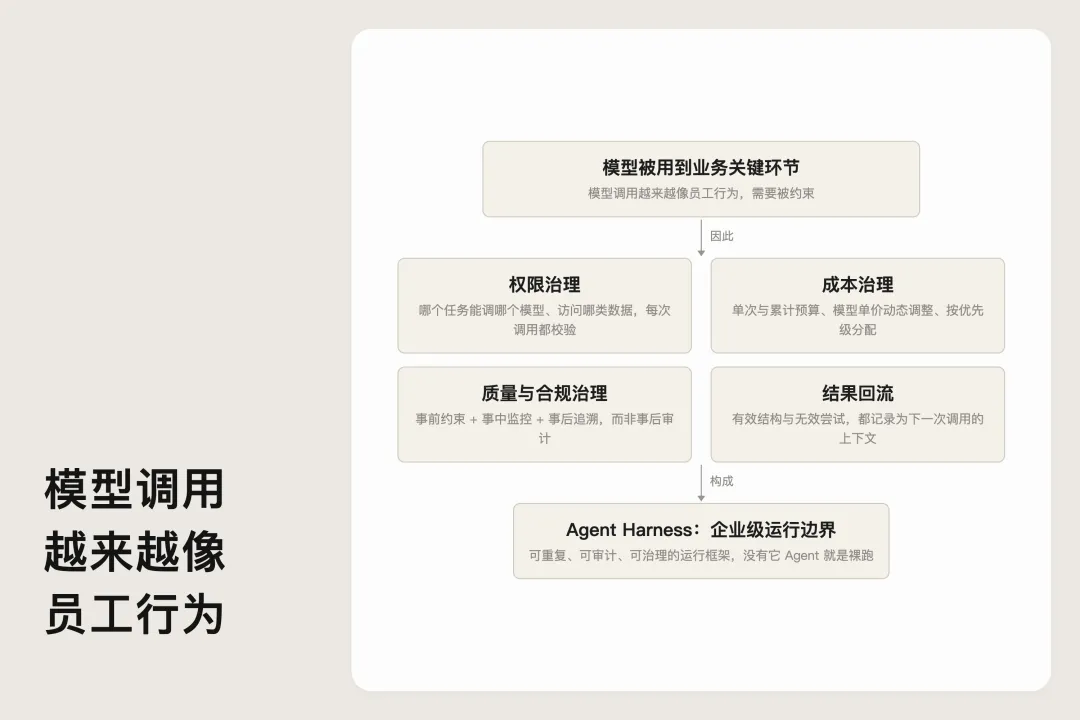
Routing alone is not enough. When enterprises use models in critical business areas, a new class of problems arises: model calls increasingly resemble employee behavior and need to be constrained.
Agent Harness is a layer of structure that places 'enterprise-level operational boundaries' around model calls. It does several key things:
Permission governance: Which tasks can call which models, whether they can access certain types of data, and whether they can call certain external tools—all have clear boundaries. This is not a 'function switch,' but 'every call must be verified.'
Cost governance: Single call budgets, cumulative budgets, dynamic adjustments of model prices, and cost allocation for tasks of different priorities are all handled at this layer.
Quality and compliance governance: Compliance checks before calling, quality assessments after calling, and rollback strategies for exceptional situations—not 'post-audit,' but 'pre-constraints + in-process monitoring + post-tracing.'
Result feedback: The effective structures and ineffective attempts of each call are structured and recorded, becoming the context for the next call. This is where 'organizational capability' begins to accumulate.
The term Harness comes from engineering, originally meaning 'a fixed device that constrains a set of test cases.' In the Agent scenario, it means consistently: providing AI agents with a repeatable, auditable, and governable operational framework. An Agent without a Harness runs wild, and multi-model orchestration without a Harness is running bare.
How Does This System Operate in Tezign Model Hub ?
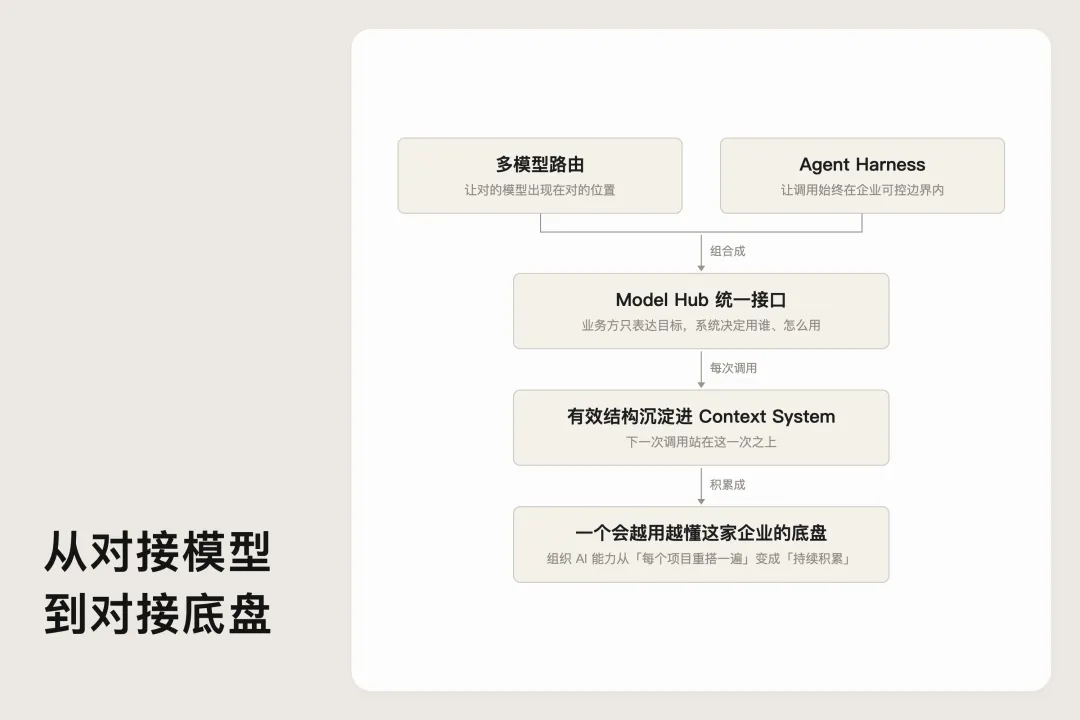
Tezign Model Hub treats these two layers of capability as core components: multi-model orchestration is responsible for 'ensuring the right models appear in the right places,' while Agent Harness is responsible for 'keeping model calls within the controllable boundaries of the enterprise.' Together, they form a complete 'model usage foundation.'
The practical change in experience is that the AI applications of enterprises no longer connect to 'the API of a specific model,' but to the unified interface provided by the Model Hub—business parties express goals, and the Model Hub decides who to use, how to use it, and how to retain the results.
This change has two layers of significance for enterprises. The first layer is efficiency: the cost of connecting models has shifted from people to systems. The second layer is more important: the path to organizing AI capabilities has shifted from 'rebuilding for each project' to 'continuously accumulating on the foundation.' The effective structure of each call is retained by the Harness in the Context System, allowing the next call to build on this one.
Multi-model orchestration and Agent Harness are not the answers for all scenarios. In cases where tasks are simple, call volumes are low, and fault tolerance is high, adding these two layers is over-design; in enterprises with immature governance systems, forcing in Harness may instead become a business bottleneck— the stricter the boundaries drawn, the greater the loss of flexibility.
But the trend is clear: the competitive focus of enterprise AI is shifting from 'which model is the strongest' to 'who can organize the models and allow organizational capabilities to continue to accumulate.' In the single model era, what was purchased was a set of tools; in the multi-model + Harness era, what is purchased is a foundation that will understand this enterprise better as it is used.
For enterprises making AI procurement decisions, rather than comparing model performance rankings, it is better to first ask: in this system, who is responsible for routing, and who is responsible for constraints? If the answer is 'each employee themselves,' then what is purchased is a set of tools; if the answer is a platform with continuous learning capabilities, then what is obtained is a foundation that will become smarter.
Category
All
Date
2026-11-02
Read Time
7 min read
Related Recommendations

Systematic Evaluation of AI Content (Eval): Why the Evaluation Process Matters More Than the Evaluation Result

Why Benchmarking Large Models Can't Tell You If This AI Is Right for Your Business?